A missed call is not always just a missed call.
For a professional firm, it may be a prospect who already researched the firm, compared options, read reviews, checked services, and finally felt ready to speak with someone.
Then the call went unanswered.
That moment matters for attorneys, CPAs and tax professionals, financial advisors, mortgage professionals, and insurance agencies because high-trust decisions are often personal, time-sensitive, and emotional. A person may not call at the perfect time for the firm. They may call during lunch, after business hours, before work, between meetings, or during a stressful situation.
If no one answers, many callers do not leave a voicemail.
They keep moving.
The issue is not that every missed call becomes a lost client. That would be too simplistic. The issue is that missed calls create a gap between interest and response, and that gap can weaken the momentum the firm already earned.
The Core Answer: Why Missed Calls Cost Professional Firms Clients
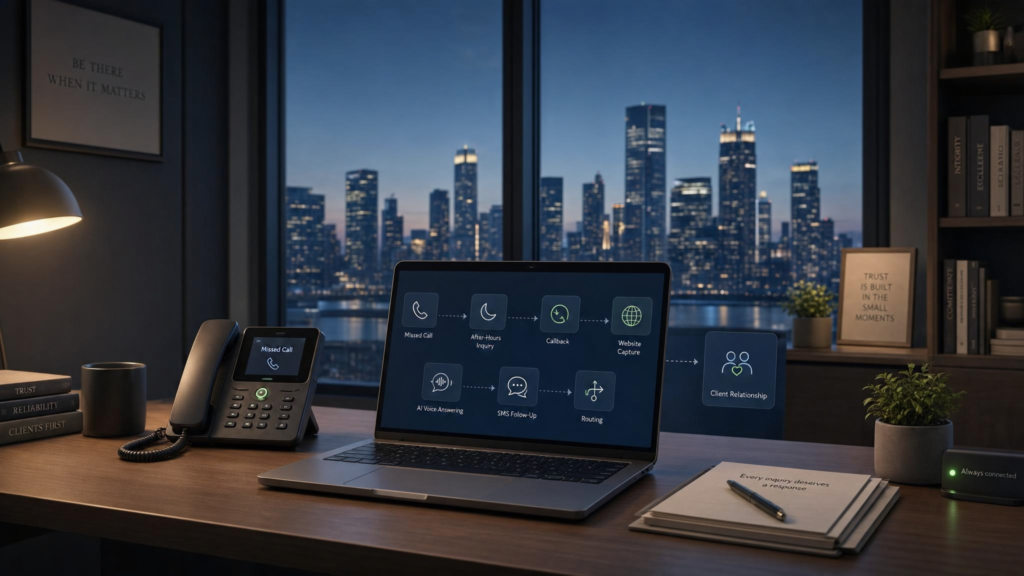
When a professional firm misses a call, many prospects do not leave a voicemail or call back. They contact the next firm on their list. Firms handle this risk with a combination of structured phone coverage, prompt callback processes, website capture, and after-hours answering, so the first contact attempt is not the last.
A missed call does not automatically mean the opportunity is gone. But it does mean the firm has lost control of the first response moment, and if the caller receives only silence or voicemail, the easiest next path may be another firm.
Answering more calls does not guarantee more clients. It protects interest the firm has already earned, so fewer ready-to-talk prospects are lost to silence.
Key Takeaways
- Many professional inquiries happen after the prospect has already researched the firm.
- First-time callers often do not want to leave a voicemail and wait.
- After-hours, lunch-hour, and busy-period gaps can affect inquiry capture.
- Professional firms can reduce missed-call risk through phone coverage, callback processes, website capture, and after-hours answering.
- AI voice answering can help capture and route inquiries, but it should not provide legal, tax, financial, mortgage, or insurance advice.
- Capturing the inquiry is only the first step. The firm still needs a prompt and appropriate follow-up process.
- Better phone coverage does not guarantee clients, but it can help protect the interest a firm already earned.
The Moment Behind the Call: Prospects Reach Out When They Are Ready
Most prospects do not call a professional firm randomly.
They call after a moment of readiness.
That readiness may come after reading the firm’s website, reviewing service pages, checking Google Business Profile, scanning reviews, reading an article, using AI search, comparing firms, or asking someone they trust.
By the time the prospect calls, they may have already answered several questions privately:
- Does this firm seem relevant?
- Do they handle my type of issue?
- Do they serve my area?
- Do the reviews feel credible?
- Does the website make sense?
- Is this firm worth contacting?
- What should I ask first?
That pre-call research matters.
Evoltra’s article on why prospects research before they call explains how people often use Google, AI search, directories, reviews, and service pages before making contact.
The phone call is often not the beginning of the journey.
It is the point where private research turns into action.
That is why missed calls matter. The caller may have reached a decision point. They may be choosing between several professional firms. They may be in the narrow window where the need feels urgent enough to act.
If the firm misses that moment, the prospect may not restart the process later.
What Really Happens After a Missed Call
When a call goes unanswered, firms often assume the caller will leave a voicemail.
Sometimes they do.
Many times, they do not.
A first-time caller may hesitate to leave a message, and the caller may also be comparing options.
If the first firm does not answer, the next step is often simple: call another firm.
This is especially true when the prospect’s need feels immediate.
An adult child trying to reach an elder law attorney may not want to wait. A business owner with a tax concern may keep searching. A borrower with a mortgage question may contact another professional. A client reviewing insurance coverage may call the next agency. A person looking for financial guidance may move to a firm that makes the next step clearer.
This does not mean the first firm was not qualified.
It means the first firm was not reachable at the moment the prospect was ready.
That is the “next-firm effect.”
The caller may not be angry. They may not think poorly of the firm. They may simply continue down the list.
Silence rarely builds trust.
A clear response path does.
Why Voicemail Often Fails First-Time Callers
Voicemail can still be useful for existing clients, internal communication, or non-urgent matters.
But for first-time prospects, voicemail often creates friction.
The caller may wonder:
- Will anyone call me back?
- When will they call?
- Should I explain the whole situation?
- Is this the right department?
- Did I call the right firm?
- Will my message be understood?
- Is there a faster option?
For high-trust services, callers may also feel uncomfortable leaving personal details on a recording.
An estate planning or probate prospect may be dealing with family stress. A tax prospect may be worried about a deadline. A mortgage borrower may have time-sensitive questions. An insurance prospect may need coverage guidance. A financial planning prospect may not want to summarize private concerns in a voicemail.
The more sensitive the topic, the more important the response path becomes.
Voicemail can document interest.
It does not always protect momentum.
Why After-Hours and Lunch-Hour Gaps Matter More Than Firms Think
Professional firms often think about missed calls only after business hours.
That matters, but it is not the only gap.
Calls can be missed during:
- lunch breaks,
- staff meetings,
- court appearances,
- client appointments,
- tax season overload,
- market volatility,
- open enrollment periods,
- mortgage rate changes,
- insurance renewal periods,
- holidays,
- early mornings,
- evenings,
- weekends,
- short-staffed days.
A prospect does not always know or care why the call was missed.
They only experience the result.
No answer.
For professional firms, the issue is not whether every call must be answered by a person instantly. That is not realistic for many firms.
The issue is whether the firm has a structured plan for the calls it cannot answer live.
After-hours coverage matters because many prospects search and make contact outside normal office hours. Lunch-hour coverage matters because many prospects call when they have a free moment during their own workday.
The firm may be closed.
The prospect may be ready.
That mismatch is where opportunities can slip away.
How Firms Cover the Gap
Professional firms can reduce missed-call risk in several ways.
The right approach depends on the firm’s size, service model, budget, staffing, compliance needs, and inquiry volume.
The goal is not to create a complicated system.
The goal is to make sure the first contact attempt is not the last.
Reception Processes
Some firms improve coverage through a stronger internal reception process.
That may include clearer phone routing, backup coverage, defined coverage windows, internal handoff expectations, and better visibility into missed calls.
This can work well for firms with staff capacity.
The challenge is consistency.
Even strong internal teams can miss calls during busy periods, meetings, lunch, after-hours windows, or seasonal surges.
A reception process helps, but it needs to account for real workdays, not ideal workdays.
Prompt Callback Processes
A missed call is less damaging when the callback process is prompt and structured.
The firm should know:
- who reviews missed calls,
- how quickly callbacks are prioritized,
- what information is captured,
- how inquiries are routed,
- when after-hours calls are returned,
- how urgent inquiries are handled,
- how follow-up is documented.
This is not about aggressive follow-up.
It is about reliability.
A prospect who leaves a message should not disappear into an inbox no one checks until the next day.
A prompt callback process helps restore momentum.
Website Capture
Not every prospect wants to call.
Some prefer to submit a form, start a website chat, request an appointment, or ask a basic question online.
Website capture can support callers who cannot reach the firm or who prefer a different first step.
A website chatbot can help visitors find the right page, ask basic routing questions, and capture inquiries when the firm is not available live.
That is a different path from phone answering, but the purpose is related: reduce the number of serious prospects lost because no clear response path exists.
Evoltra’s Website Chatbot service explains how website capture can support visitors without replacing professional judgment.
After-Hours Answering
After-hours answering gives prospects a response path when the office is closed.
That coverage may involve a live answering service, a structured phone system, an AI voice receptionist, or a combination of approaches.
The best option depends on the firm.
The principle is the same:
When a prospect calls outside business hours, the firm should still be able to capture basic information, set expectations, and route the inquiry appropriately.
After-hours answering does not need to pretend the office is open.
It should be transparent, useful, and aligned with the firm’s standards.
AI Voice Answering
An AI voice receptionist can answer calls, capture basic information, route inquiries, and help schedule or direct the next step based on the firm’s approved process.
Used properly, it supports coverage.
It does not replace the relationship.
It should not provide professional advice.
For firms that miss calls after hours or during busy periods, Evoltra’s AI Voice Receptionist service is designed to help protect ready-to-talk inquiries by giving callers a response path when staff are unavailable.
What an AI Voice Receptionist Should and Should Not Do
AI voice answering should be framed honestly.
It is not a lawyer, CPA, advisor, mortgage professional, or insurance agent.
It is a capture and routing tool.
What It Should Do
An AI voice receptionist can help a professional firm:
- answer when staff are unavailable,
- greet callers professionally,
- capture name and contact information,
- identify the general reason for the call,
- route inquiries to the right person or department,
- help schedule where appropriate,
- provide basic firm-approved information,
- set expectations about follow-up,
- reduce reliance on voicemail,
- support after-hours inquiry capture.
The best use is simple and practical.
The caller should know they reached the firm and that their inquiry has a path forward.
What It Should Not Do
An AI voice receptionist should not:
- give legal advice,
- give tax advice,
- give financial advice,
- give mortgage advice,
- give insurance advice,
- evaluate a caller’s case,
- recommend a strategy,
- promise outcomes,
- quote individualized terms,
- imply a professional relationship has been formed,
- replace firm review or human follow-up.
This boundary matters.
A caller may want answers quickly, but high-trust services require professional judgment.
Technology can capture the inquiry.
The firm still needs to evaluate it.
Will Callers Be Bothered by AI Answering?
Some firms worry that callers will dislike AI answering.
That is a reasonable concern.
The experience matters.
A poor AI answering experience can feel frustrating, impersonal, or confusing. But a clear, respectful, well-structured answering experience can be better than silence or a voicemail box, especially when the caller only needs to know that the firm received the inquiry and will follow up.
The key is expectation setting.
An AI voice receptionist should be transparent, calm, and limited to appropriate tasks. It should not pretend to be a professional. It should not over-answer. It should not trap callers in a confusing loop.
Most callers want a simple outcome:
They want to know they reached the right place and that someone will respond.
When AI answering supports that outcome, it can reduce friction.
When it tries to do too much, it creates risk.
Connecting Phone Coverage to Follow-Up
Capturing the call is only the first step.
A professional firm still needs a follow-up process.
If an AI voice receptionist captures an inquiry at 8:30 p.m., someone should know what happens next. If a call comes in during lunch, the firm should know who reviews it. If a weekend inquiry is captured, the firm should have expectations for when it will be addressed.
Phone coverage without follow-up can create a new kind of frustration.
The prospect reached the firm.
The firm captured the information.
Then nothing happened.
That is why phone answering should connect to a structured follow-up process.
For some firms, that may include internal callback rules. For others, it may include structured SMS follow-up, reminders, scheduling workflows, or CRM routing.
Evoltra’s SMS Lead Automation service supports this part of the capture process by helping firms follow up with inquiries in a more structured way.
For the bigger picture of how phone, chat, forms, and follow-up work as one system, Evoltra’s article on AI intake systems for professional firms covers the full capture path.
The purpose is not to overwhelm prospects with messages.
The purpose is to make sure captured interest does not disappear.
What Professional Firms Should Review Before Adding Phone Automation
Before adding any phone automation, a firm should understand where the real gaps are.
At a high level, review:
| Area | What to Ask |
| Missed calls | When are calls most often missed? |
| After-hours inquiries | Do prospects call before or after business hours? |
| Lunch-hour coverage | Is the phone covered during common break times? |
| Busy periods | Are seasonal or high-volume periods creating gaps? |
| Voicemail use | Are first-time callers leaving useful messages? |
| Callback process | Who follows up, and how quickly? |
| Routing | Do inquiries reach the right person? |
| Website capture | Is there another path when callers cannot reach the firm? |
| Follow-up | Are captured inquiries documented and returned? |
| Compliance boundaries | Is the system limited to capture, scheduling, and routing? |
This is not a technical setup guide.
It is a strategic look at where the firm may be losing ready-to-talk prospects.
How This Looks Across Professional Firms
The missed-call problem shows up differently by industry, but the underlying pattern is similar.
Attorneys
A legal prospect may call when a problem feels urgent or emotionally heavy. They may be dealing with probate, estate planning, elder law concerns, family issues, business matters, or another sensitive situation.
If the call goes unanswered, they may not leave details on voicemail.
They may call another firm.
An AI voice receptionist should not give legal advice or evaluate the matter. It can capture basic information, route the inquiry, and help the firm respond appropriately.
CPAs and Tax Professionals
A tax or accounting prospect may call because of a deadline, a notice, a planning question, or a business concern.
During tax season or busy advisory periods, staff may not be able to answer every call.
Structured phone coverage can help capture inquiries without creating the impression that the caller has received tax advice.
Financial Advisors
A financial planning prospect may call after researching the firm, reading about retirement planning, or comparing advisors.
They may not want to leave personal financial details on voicemail.
An answering process can capture basic contact information and route the inquiry, while leaving advice and recommendations to the advisor.
Mortgage Professionals
Mortgage prospects often call when timing matters.
They may be asking about purchase readiness, refinance questions, preapproval, documentation, or next steps.
High-intent conversations can start before the first call, especially when borrowers have already researched online, compared options, or reviewed service information.
Evoltra’s article on high-intent refinance conversations explains how borrower intent can form before the first conversation.
Phone coverage should protect that moment without promising rates, approvals, timelines, or loan outcomes.
Insurance Agencies
Insurance prospects may call because of a renewal, claim concern, coverage question, life change, business need, or policy review.
If they cannot reach the agency, they may contact another provider.
An answering system can capture the inquiry and route it, but it should not make coverage recommendations without proper review.
Why This Is a Capture Problem, Not Just a Phone Problem
Missed calls are part of a larger capture issue.
A firm may already be doing the hard work of earning attention.
It may have invested in:
- referrals,
- Google visibility,
- AI search visibility,
- reviews,
- service pages,
- educational content,
- Google Business Profile,
- directory profiles,
- website improvements,
- reputation building.
But if a ready prospect calls and no one answers, the firm may lose the benefit of that visibility.
This is why capture matters.
Visibility helps a prospect find and trust the firm.
Capture helps protect the moment when the prospect acts.
The Authority Score assessment can help a firm understand whether its public presence is helping prospects move from discovery to trust to contact, and where friction may be interrupting that path.
What Good After-Hours Handling Should Feel Like
A good after-hours experience should feel simple, respectful, and professional.
The caller should understand:
- they reached the right firm,
- their inquiry was received,
- what basic information is needed,
- whether the matter will be routed,
- when they can reasonably expect follow-up,
- how to take another appropriate next step if needed.
The experience should not feel pushy.
It should not overpromise.
It should not pretend to replace professional review.
For high-trust firms, the best after-hours handling is not flashy. It is reliable.
That reliability protects confidence.
Common Mistakes Firms Make With Missed Calls
Missed-call problems often persist because firms underestimate small gaps.
Common mistakes include:
- assuming most first-time callers will leave a voicemail,
- assuming every missed call will call back,
- checking voicemail too late,
- having no backup during lunch,
- treating after-hours calls as low priority,
- using website forms that are hard to find,
- failing to route inquiries clearly,
- not documenting captured calls,
- adding automation without a follow-up process,
- allowing technology to answer questions it should route instead.
These mistakes are understandable.
Professional firms are busy, and most are built around client work first.
But a firm that earns attention also needs a way to protect it.
What Evoltra Helps Firms Build
Evoltra Solutions helps high-trust professional firms become easier to find, understand, trust, and choose across Google, AI search, website clarity, reviews, business profiles, service pages, and inquiry capture.
For phone capture, the goal is not to replace the firm’s people.
The goal is to protect the moment when a prospect is ready to talk and the firm is not available live.
That may involve AI voice answering, structured SMS follow-up, website capture, clearer inquiry paths, or broader visibility and capture planning.
Every firm’s needs are different.
A smaller firm may need after-hours coverage. A growing firm may need better routing. A busy firm may need to reduce voicemail dependence. A firm with strong visibility may need a stronger capture system so inquiries do not disappear.
Evoltra does not promise more clients, higher rankings, AI citations, AI mentions, lead volume, or immediate results.
The focus is practical:
Reduce avoidable silence.
Capture serious inquiries.
Route them appropriately.
Support timely follow-up.
Protect the trust the firm already earned.
Final Thoughts: The First Call Is a Moment of Readiness
A prospect who calls your firm may have already done the research.
They may have compared you with others.
They may have read your reviews.
They may have checked your services.
They may have used Google or AI search.
They may have decided your firm was worth contacting.
That call is a moment of readiness.
When it goes unanswered, the prospect may not leave a voicemail or try again later. They may simply contact the next firm.
Professional firms do not need technology that pretends to replace relationships.
They need systems that protect the beginning of one.
Structured phone coverage, prompt callbacks, website capture, AI voice answering, and thoughtful follow-up can all help make sure the first contact attempt is not the last.
Answering the call is not the whole relationship.
But it may be what allows the relationship to begin.
Frequently Asked Questions
Do callers really avoid leaving voicemails?
Many first-time callers avoid leaving voicemails, especially when they are comparing firms or asking about a sensitive issue. Some will leave a message, but professional firms should not assume voicemail will capture every serious inquiry.
Can an AI receptionist answer legal or financial questions?
No. An AI receptionist should not answer legal, tax, financial, mortgage, or insurance questions that require professional judgment. It should capture basic information, route the inquiry, help schedule where appropriate, and set expectations for human follow-up.
Will clients be bothered by an AI answering?
Some callers may prefer a human, so the experience needs to be clear and respectful. When handled well, AI answering can be more useful than silence or voicemail because it confirms the caller reached the firm and gives the inquiry a path forward.
What is the difference between an answering service and an AI voice receptionist?
An answering service usually uses live agents to answer calls and take messages. An AI voice receptionist uses approved automation to answer, capture information, route inquiries, and support scheduling or follow-up paths. Both should be limited by the firm’s professional and compliance boundaries.
Does answering more calls guarantee more clients?
No. Answering more calls does not guarantee more clients, leads, consultations, or revenue. It helps protect interest the firm has already earned by reducing the number of ready-to-talk prospects lost to silence.
What should happen after an after-hours inquiry is captured?
The inquiry should be routed to the right person or process, documented, and followed up promptly according to the firm’s standards. Capture without follow-up can create frustration and weaken trust.