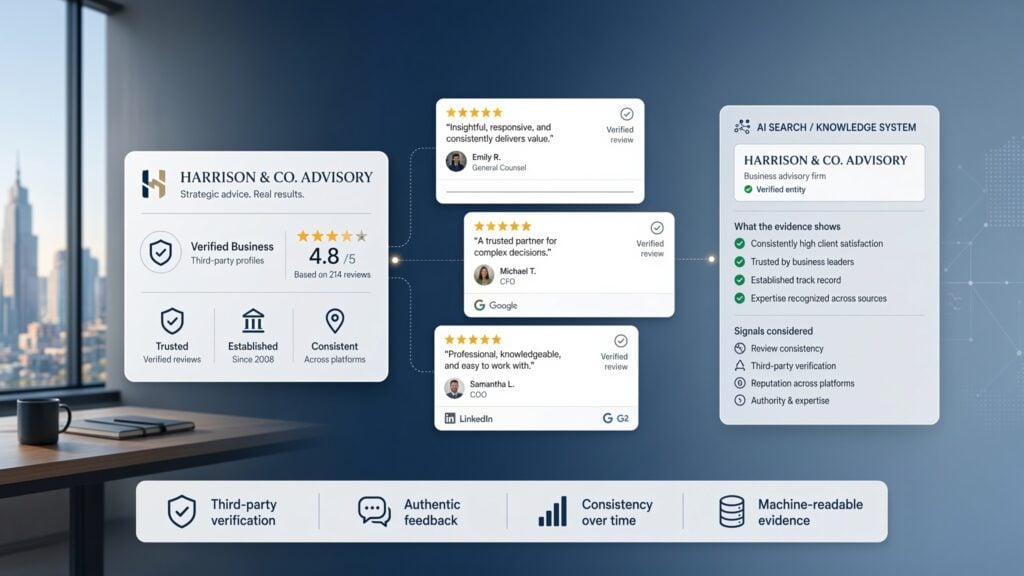
For years, professional firms treated reviews mainly as social proof. A strong rating reassured a potential client that other people had a good experience.
That role still matters. But it is no longer the whole story.
Reviews now form part of the public information surrounding a business. Search engines can use review data when evaluating local prominence, while AI-powered search experiences rely on search systems and publicly accessible information to assemble answers.
For attorneys, CPAs, financial advisors, mortgage professionals, and insurance agencies, that changes the role of reputation management. Your reviews are not simply persuading prospects. They help create a public record that supports, clarifies, or sometimes contradicts what your firm says about itself.
The Core Answer: Why Reviews Matter in AI Search
Reviews matter in AI search because they provide outside confirmation of a firm’s own claims.
A website tells search systems what a firm says it does. Reviews provide independent public evidence from people describing their experiences with that firm.
Google explicitly confirms that review count and positive ratings can contribute to local search ranking. Google also says its generative AI search features are rooted in its existing Search ranking and quality systems.
That does not mean every review sentence becomes an AI ranking factor. Google does not publish such a formula.
It does mean review patterns form part of the broader information environment that helps search systems and people understand a business. Recency, specificity, response activity, and consistency can make that public record easier to interpret.
For professional firms, reviews have therefore become both human trust signals and machine-readable evidence.
Strong reviews do not guarantee rankings, AI citations, or new clients. They strengthen the signals that help people and systems trust what your firm says about itself.
Key Takeaways
- Reviews provide third-party corroboration. They add outside evidence to claims made on your website and business profiles.
- Google confirms that reviews affect local visibility. Review count and positive ratings can contribute to local ranking.
- AI search and traditional search are connected. Google says its generative AI experiences are rooted in core Search ranking and quality systems.
- Review patterns matter beyond the average star rating. Current activity, detailed language, response behavior, and consistency can make a firm’s public reputation easier to understand.
- A stale profile creates an information gap. A high historical rating does not tell a prospect as much about the firm operating today.
- Owner responses become part of the public record. They demonstrate how a firm handles appreciation, questions, concerns, and criticism.
- Ethical practices are essential. Fake or manipulated reviews can violate platform policies and, in some circumstances, federal rules.
Reviews Were Social Proof. Now They Are Also Machine Evidence
A traditional view of reviews is simple: someone sees a 4.8-star rating, feels reassured, and becomes more willing to contact the firm.
That still happens.
The newer consideration is that review information exists inside an ecosystem that search engines can process.
Google states that user-contributed content may appear across services including Maps and Search. It also confirms that the number of reviews and positive ratings can contribute to local search ranking.
At the same time, Google’s AI Overviews and AI Mode rely on its Search infrastructure. Google describes these AI experiences as using search and retrieval systems to identify relevant information from its index.
This creates an important distinction.
Your website is first-party evidence. Reviews are third-party evidence.
Suppose an accounting firm describes itself as specializing in small-business tax planning. That is useful information. If its public profiles and authentic reviews repeatedly reference tax planning, business owners, responsiveness, and the same geographic market, the outside information reinforces the entity the website describes.
The goal is not to manufacture keywords inside reviews. Firms should never dictate what clients write.
The point is that authentic customer language can help create a richer and more consistent public understanding of what the business actually does.
That broader verification layer is one reason AI search needs more than a website.
What Search and AI Systems Can Read in a Review Pattern
A review profile contains more information than a single average rating.
Search systems can process structured and unstructured public information. For human prospects, the same information creates a pattern that communicates whether the reputation looks current, credible, and consistent.
Google does not publicly state that each characteristic below is an independent AI ranking factor. They are better understood as features of the public evidence surrounding a firm.
| Review Signal | What It Helps Confirm |
| Recency | The firm is active and receiving current feedback |
| Specificity | Reviewers describe services, locations, or experience clearly |
| Volume and pattern | Reviews appear naturally over time instead of in unnatural bursts |
| Owner responses | The firm communicates professionally in public |
| Consistency | Reviews match the website, profiles, and service focus |
These signals work together. A firm with one old review and a polished website may still be credible, but the public evidence is thin.
Recency
A review from several years ago documents an experience from several years ago.
A continuing stream of genuine reviews provides more current evidence that the business remains active and that people are still interacting with it.
This distinction matters because AI-powered search increasingly emphasizes current information. Google describes retrieval-augmented generation in Search as a way to retrieve relevant and up-to-date information from its index.
Recency therefore changes the informational value of the review profile even without a published “review freshness” AI ranking factor.
Specificity
Compare two hypothetical reviews:
“Great firm. Highly recommend.”
and
“The team helped us understand the tax implications of restructuring our small business and explained each step clearly.”
The second contains more context.
It identifies the type of firm, the general service involved, the audience, and qualities of the experience. Specific reviews can therefore provide stronger descriptive evidence than generic praise.
For a professional firm, authentic specificity helps clarify what the business is known for.
Volume and Pattern
One review tells you about one experience.
A larger collection creates a pattern.
Google explicitly states that review count and review score contribute to local ranking.
Volume should never be viewed as permission to chase reviews artificially. Google’s policies require reviews to reflect genuine experiences, and suspicious activity can lead to review removal or Business Profile restrictions.
The useful signal is an authentic pattern, not a manufactured number.
Owner Responses
Reviews are not the only public text on a review profile. Responses are public too.
Google tells businesses that replying demonstrates that they value customer feedback and says helpful, positive replies can help a business stand out.
For a professional firm, a thoughtful response can reinforce professionalism without revealing confidential information or discussing sensitive details.
Consistency With Other Public Information
Reviews do not exist in isolation.
Search systems also encounter your website, Google Business Profile, directories, professional listings, articles, and other public references.
When those sources consistently describe the same firm, location, services, and areas of expertise, the entity becomes easier to understand.
If they conflict, uncertainty increases.
This is why reviewing whether your Google Business Profile is helping or hurting is part of a broader reputation conversation. The profile, website, and review footprint should describe one recognizable business.
Why a Stale Review Profile Sends the Wrong Signal Even With a High Rating
A 5.0-star rating looks excellent at first glance. But if the newest review is from three years ago, it leaves an unanswered question:
What is the client experience like now?
A stale profile does not automatically mean the firm provides poor service. It simply provides less current evidence.
That difference matters for high-trust professional services.
Staff changes. Partners change. Offices move. Service areas evolve. Technology changes how clients communicate with the firm. A historical review may still be accurate, but its ability to describe the present business decreases with time.
This is why a 4.7 rating supported by continuing, credible feedback can sometimes tell a prospect more than a perfect rating built entirely from old reviews.
The comparison is not “4.7 beats 5.0.” Google does not publish such a rule.
The meaningful distinction is current evidence versus historical evidence.
A healthy reputation should make it easy for someone researching the firm to understand that real clients are still interacting with the business today.
That principle becomes especially important when examining what prospects see when they search your firm by name.
Owner Responses: The Underused Trust Signal
A review tells the public something about the client.
A response tells the public something about the firm.
That makes owner responses particularly important for professional services, where prospects often evaluate communication style before they ever schedule a consultation.
Google says businesses can publicly reply to reviews and notes that helpful responses show customers that their feedback matters.
The value becomes especially clear with negative feedback.
A defensive response can create more concern than the original complaint. A calm response can show that the firm listens, communicates professionally, and handles difficult situations with restraint.
For attorneys, financial advisors, CPAs, mortgage professionals, and insurance agencies, confidentiality is essential. A response should never reveal private facts merely to win a public disagreement.
A professional response can acknowledge the feedback without confirming confidential details.
Owner responses also add current first-party text to the review environment. They can reinforce professionalism, responsiveness, and the firm’s identity without attempting to manipulate the review itself.
The review describes the experience. The response demonstrates how the firm handles the relationship.
That distinction makes responses a valuable part of a broader Reputation Management strategy.
Reviews and Referrals: Why Referred Prospects Still Check
A personal referral does not end online research.
It starts it.
Imagine that a business owner asks a colleague for a CPA recommendation. The colleague provides a name. The prospect then searches the accounting firm before making contact.
The referral created awareness. Search validates the choice.
The prospect may see the firm’s website, Google Business Profile, reviews, professional directories, social profiles, and other references. Together, those sources answer questions the referral may not have addressed:
- Is the firm still active?
- Does it serve businesses like mine?
- Is the location correct?
- What do clients repeatedly mention?
- How does the firm respond when someone has a concern?
- Does the public reputation match what I was told?
AI-assisted search makes the same underlying consistency increasingly relevant because it can synthesize information rather than simply present ten blue links.
Google says AI Mode and AI Overviews can conduct multiple related searches across subtopics and data sources while preparing a response.
That makes a scattered online presence more consequential.
A trusted introduction remains powerful. But referrals still need a strong online presence because prospects commonly verify professional firms before taking the next step.
Referral trust and search trust are not competing forces. Search is often where referral trust gets confirmed.
What Ethical Review Practices Look Like for Professional Firms
The growing importance of reviews does not justify manipulating them.
Professional firms should treat reviews as evidence of genuine client experiences, not as a metric to manufacture.
Google’s Maps policies prohibit content that does not reflect a genuine experience. Google also uses automated systems and human review to detect policy-violating contributions.
The Federal Trade Commission’s Consumer Reviews and Testimonials Rule, effective October 21, 2024, also prohibits several deceptive practices involving fake or false reviews. The rule prohibits businesses from buying reviews when compensation is conditioned on a particular positive or negative sentiment.
For professional firms, an ethical approach means:
- ask clients for honest feedback consistently rather than selectively targeting only people expected to leave praise;
- never buy, fabricate, or exchange fake reviews;
- never condition a reward on a positive rating or particular sentiment;
- follow the policies of the platform where the review appears;
- consider industry-specific advertising, solicitation, confidentiality, and professional-conduct rules;
- avoid telling clients what to say;
- protect confidential information when responding publicly.
Platform policies can be stricter than the minimum required by federal law. Professional rules can add another layer.
For that reason, this article does not recommend incentives as a review strategy. The safest trust-building principle is simple: authentic reviews should reflect authentic experiences.
A firm’s review profile is stronger when the evidence is credible enough to withstand scrutiny from both people and platforms.
What Reviews Cannot Do
Reviews matter, but they are not magic.
They cannot guarantee rankings, AI citations, new clients, or lead volume, and they cannot repair a reputation by themselves.
A strong review profile also cannot compensate for every other weakness. If a firm’s website is unclear, its service pages are thin, or its business profiles are inconsistent, reviews may not be enough to carry the entire trust experience.
Reviews are one layer in a broader visibility system. They work best when aligned with the firm’s website, service pages, profiles, and content.
A simple way to evaluate your own review presence is to look at the public pattern the way a prospect or a search system would:
| Area | What to Notice |
| Recency | Are reviews current enough to reflect the firm today? |
| Specificity | Do reviews mention services, locations, communication, or client experience? |
| Pattern | Do reviews appear naturally over time? |
| Responses | Does the firm respond calmly and professionally? |
| Consistency | Do reviews match the website, profiles, and service pages? |
| Ethics | Are reviews genuine, unbiased, and never incentivized? |
| Confidentiality | Do responses protect private client details? |
This is not about chasing a perfect rating. It is about building a review presence that helps people and systems trust the firm’s public story.
If you want a broader picture of how those signals fit together, an Authority Score assessment can help identify gaps across the firm’s online trust footprint.
The Bottom Line
Reviews have moved beyond their traditional role as star ratings for prospective clients.
They now contribute to the larger public evidence surrounding your firm.
Google confirms that reviews influence local search visibility, that review content can appear across Google services, and that its generative AI search experiences are built on core Search systems.
For professional firms, the practical lesson is not to chase a perfect rating.
It is to build a public reputation that looks genuine, current, specific, professionally managed, and consistent with the rest of your online presence.
Your website says who you are.
Your reviews help other people, and increasingly the systems organizing public information, verify that story.
Strong reviews do not guarantee rankings, AI citations, or new clients. They strengthen the signals that help people and systems trust what your firm says about itself.
Frequently Asked Questions
Do AI systems really read reviews?
AI search systems can draw on many types of publicly accessible information, and reviews form part of the public information surrounding a business. Google specifically says user-contributed content can appear across products such as Maps and Search, and that its generative AI search experiences rely on core Search ranking and quality systems.
However, businesses should not interpret this as proof that every review is directly fed into every AI answer. AI products differ, and Google does not publish a review-specific AI citation formula. The practical point is simpler: authentic reviews contribute to the public evidence through which a business can be discovered, described, and evaluated.
Is a 5.0 rating with old reviews better than a 4.7 with recent reviews?
Not necessarily. The numerical rating is only one part of what a prospect can evaluate. A 5.0 profile with no activity for several years provides strong historical sentiment but limited current evidence. A 4.7 profile with credible, ongoing feedback can provide more information about the business as it operates today.
Google confirms that review count and positive ratings can influence local ranking, but it does not publish a formula saying that recent reviews automatically outweigh older reviews. Evaluate the complete pattern, not one decimal point.
Should professional firms respond to negative reviews?
Yes, when they can do so professionally and without revealing confidential information. A response allows future prospects to see how the firm handles criticism. Google also encourages businesses to respond to reviews and states that helpful responses can demonstrate responsiveness to customers.
The goal is not to win a public argument. A good response acknowledges the concern, stays calm, protects privacy, and moves sensitive discussion to an appropriate private channel.
Can professional firms ask clients for reviews?
Generally, businesses can ask customers for authentic reviews, but professional firms must also follow applicable platform and industry rules. Google provides businesses with tools for requesting reviews. The FTC’s guidance also distinguishes legitimate review solicitation from deceptive practices such as fake reviews or incentives conditioned on positive sentiment.
Attorneys, financial professionals, and other regulated firms should additionally consider their professional advertising, confidentiality, testimonial, and solicitation requirements.
Do keywords in reviews help AI search visibility?
Review language can help describe what customers associate with a business, but firms should not attempt to script keyword-rich reviews. Authentic specificity is valuable because it creates clearer public context. Manipulated language weakens the credibility of that evidence and can create policy problems. Encourage honest feedback, not predetermined wording.
Are reviews more important than a firm’s website?
No. Reviews and the website serve different purposes. Your website is the primary source for explaining your services, expertise, people, locations, and positioning. Reviews provide outside corroboration. The strongest digital presence aligns first-party information with credible third-party evidence.